From Click to Customer: The Skills Behind Modern Supply Chains

Purchasing has changed dramatically. 

Customers can discover a product, compare their options and complete a purchase within minutes. With online shopping, digital marketplaces and convenient delivery options, speed has become a fundamental part of the customer experience in all commercial businesses. 

However, that simple transaction relies on a much wider supply chain & logistics operation. 

Products need to be available, and suppliers need to be managed to ensure product can be provided almost instantly. Potential risks also need to be identified, and customer demand needs to be anticipated. Much of this work happens before a customer ever reaches the point of purchase. 

As customer expectations continue to grow, businesses need people with the commercial and supply chain skills to keep pace. 

The rise of the immediate transaction

Digital platforms have transformed the way customers purchase products and services. Convenience and speed are increasingly expected throughout the buying journey, from finding the right product through to receiving it, and subsequently, this has also changed what customers expect from businesses. 

Product availability, convenient delivery options and shorter delivery times can all influence purchasing decisions. When those expectations are not met, customers have more opportunities than ever to look elsewhere. 

Research from DHL’s 2025 E Commerce Trends Report found that 80% of British online shoppers will abandon a purchase if their preferred delivery option is unavailable. The research surveyed 24,000 online shoppers across 24 global markets, including the UK. 

The same research found that 75% of British shoppers would leave if the returns process did not meet their expectations, demonstrating how logistics can influence the customer experience before a transaction has even been completed. 

Supply chain performance is closely connected to the customer experience. Having the right product available, at the right time and through the right channels can influence whether a customer completes their purchase. So, meeting those expectations requires industries to anticipate demand and make effective commercial decisions. 

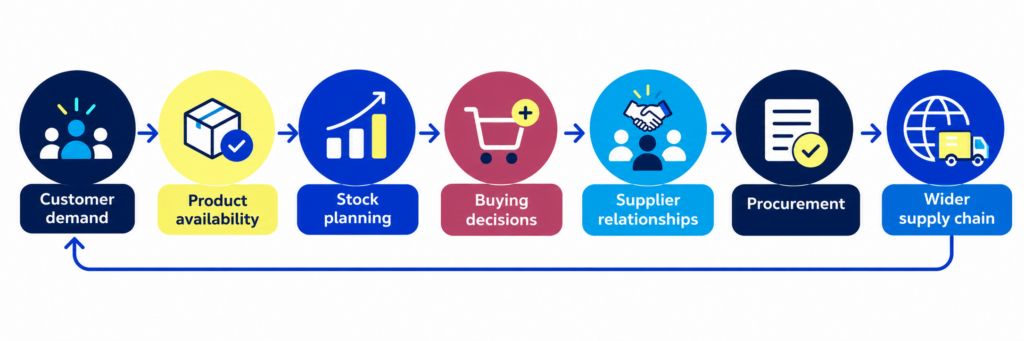
What happens behind every transaction?

A customer might only see the final transaction, but a significant amount of commercial activity has already taken place behind it. 

Each part of that process relies on people making informed decisions. So, businesses need competent staff to: 

  • Understand what the business requires and when 
  • Identify and manage suppliers 
  • Consider costs 
  • Negotiate terms  
  • Assess risks 
  • Make purchasing decisions that support wider commercial objectives.

This is why modern supply chains involve far more than simply moving products from one location to another. Strong supply chains rely on effective relationships, informed purchasing, careful planning and employees who understand how their decisions can affect the wider business. 

Supply Chain Process- AI Generated

Have a question?
Reach out to us now

Don’t wait – we’re here to help. Drop us a message about the Fundraising Essentials course and we’ll get back to you right away.

Whether it’s a quick question or something more, fill out the form below and let’s connect today!

Please let us know what's on your mind. Have a question for us? Ask away.
Stay Connected(Required)
Stay informed about exciting training opportunities from Fareport. Select 'Yes' to receive updates, you can unsubscribe anytime.

What commercial skills do modern businesses need?

As supply chains become increasingly important to business performance, employees working within them require a broad range of commercial skills. 

Supplier and stakeholder relationship management

Strong relationships can help businesses communicate effectively with suppliers, understand expectations and address potential problems before they have a wider impact. 

Negotiation

Employees need the confidence to discuss costs, terms, service requirements and expectations while considering the commercial interests of the business. 

Purchasing and procurement

Effective procurement involves understanding what the business needs, identifying appropriate suppliers and making purchasing decisions that consider cost, quality, risk and long-term value. 

Commercial decision making

Decisions made within procurement and supply chain teams can have consequences across the wider business. Employees therefore need to understand the commercial impact of the choices they make. 

Market and trend analysis

Changes in customer behaviour, pricing, supply and wider markets can affect purchasing decisions. Recognising and responding to these changes can help businesses prepare for future demand. 

Risk management

Supplier disruption, shortages, changing costs and unexpected demand can all create challenges. Understanding and managing risk is an important part of maintaining a resilient supply chain. 

Budget and cost control

Procurement teams need to balance quality and availability with financial considerations, helping the business achieve value from its purchasing decisions. 

Data informed decision making

Commercial teams have access to increasing amounts of information. Being able to interpret that data and use it effectively can support purchasing, forecasting and supplier management decisions. 

Together, these skills can help businesses strengthen supplier relationships, improve purchasing decisions, manage costs and respond more effectively to changing demand. 

Why developing skills internally matters

When a business identifies a skills gap, recruitment may seem like the natural solution. 

However, some of the people with the potential to fill those gaps may already be working within the business. 

Existing employees have an important advantage. They may already understand your customers, suppliers, products, processes and commercial priorities. Developing their skills can build on this existing knowledge while preparing them to take on additional responsibilities. 

Structured training can help employees understand the principles behind the work they already carry out, introduce new approaches and give them opportunities to apply their learning directly within their role. 

Apprenticeship training can provide a structured route for businesses looking to develop these skills within their existing workforce. 

Building commercial and supply chain skills through apprenticeships

Apprenticeships are not solely a route for recruiting new employees. They can also be used to develop eligible existing employees, providing structured training alongside their current role. 

At Fareport, our procurement and supply chain apprenticeships support development at different levels of responsibility. 

Where could the skills gaps be in your business?

As customer expectations continue to evolve, it is worth considering whether your commercial and supply chain teams have the skills they need for what comes next. 

Could purchasing decisions within your business be more commercially informed? 

Are employees confident when managing and negotiating with suppliers? 

Could supplier relationships be managed more effectively? 

Does your team have the skills to anticipate and respond to changing demand? 

Are there employees within your business who are ready to take on greater commercial responsibility? 

Developing the people behind your procurement and supply chain operations can help your business respond to changing customer expectations with greater confidence. 

Apprenticeship training provides a structured way to develop these skills within your workforce while supporting employees to progress and take on greater responsibility. 

Explore our procurement and supply chain apprenticeships and register your interest today. 

Alternatively, speak to our team on 01329 825 805. Our team is available Monday to Friday, 8am to 4pm. 

Related Posts

keyboard_arrow_up